
Hybrid & Combined
Pectus Surgery
Some chests are best corrected by combining techniques rather than relying on one. For complex or asymmetric pectus excavatum, a hybrid operation pairs a keyhole Nuss bar with a limited (“mini”) Ravitch. For selected pectus carinatum, a combined approach uses a mini-Ravitch together with bracing. The aim is always the best achievable correction through the least surgery.
Surgery at the Pectus Clinic is consultant-delivered throughout. Mr Ian Hunt assesses every patient personally and tailors the approach to the individual chest.
Combining techniques for the most reliable result
Most pectus deformities are corrected with a single technique — a Nuss repair, a modified Ravitch, or a brace. Some chests, however, do better when two approaches are combined.
For complex, asymmetric or mixed pectus excavatum, a hybrid operation pairs a keyhole Nuss bar (to lift the breastbone) with a limited “mini” Ravitch (to release and reshape the stiff or uneven cartilage). This corrects shapes that a bar alone cannot.
For selected pectus carinatum, a combined approach uses a mini-Ravitch to correct the protrusion together with bracing to fine-tune and hold the result. The plan is always individualised at consultation.
At a glance
The two approaches
Both combine a limited open (mini-Ravitch) step with a second technique. Which is used depends on whether the chest is sunken or protruding.
Hybrid — for pectus excavatum
One or more keyhole Nuss bars are placed behind the breastbone to lift it forward, combined with a limited mini-Ravitch that divides and releases the stiff or asymmetric costal cartilages. Once the sternum is released it elevates and the chest corrects far more evenly — and this release is essential both to perform the operation safely and to aid accurate bar positioning. It is suited to complex, asymmetric, mixed or rigid excavatum where bars alone are not enough. The bars typically stay for around 3–4 years before removal; where plates and screws are used (uncommonly) they usually remain permanently.
Combined — for pectus carinatum
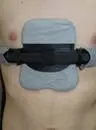
A mini-Ravitch flattens the protrusion by reshaping the cartilage and breastbone — a more limited operation than a full Ravitch, avoiding extensive dissection. It is particularly useful in older patients, typically in their 20s and 30s, with a symmetric carinatum: it makes a stiff chest flexible again while avoiding a larger open operation. A custom brace — measured and prepared before surgery — is then worn from about 2–4 weeks afterwards, typically about 12 hours a day (evenings and overnight), for around 6–9 months (variable, guided by progress), to refine and hold the corrected contour.
Who is suitable?
Suitability depends on the type, severity and flexibility of the deformity, and on previous treatment. It is confirmed after a full assessment by Mr Hunt.
✓ A combined approach is considered for
- The more complex or extreme pectus excavatum, or much older patients, where a Nuss alone (one or more bars) is unlikely to give the best correction
- Rigid or skeletally mature excavatum needing cartilage release as well as bars
- Selected pectus carinatum where surgery and bracing together give a reliable, durable result
- Recurrent or residual deformity after previous surgery
✗ Less likely to be needed when
- A straightforward symmetric excavatum suited to a standard Nuss repair
- A flexible carinatum that bracing alone can correct
- The concern is purely appearance and a less invasive option would suffice
Assessment and planning
Every patient has a structured assessment to confirm that a combined approach is the right choice and to plan exactly how the correction will be made.
The work-up mirrors the relevant single procedure: for a hybrid excavatum repair it is the same as for the Nuss procedure, and for a combined carinatum correction it is the same as for the modified Ravitch and bracing.
Brace preparation (combined cases). Because a custom brace is worn after a combined carinatum operation, the measurements and a 3D surface scan needed by the brace manufacturer are taken before surgery, so the brace is ready when it is needed.
Imaging. A CT scan with 3D reconstruction defines the pattern, severity, flexibility and symmetry of the deformity and guides which techniques to combine.
Heart & lung tests where indicated. In excavatum, or where symptoms suggest it, an echocardiogram, cardiac MRI or lung-function/CPET testing documents any functional effect.
Anaesthetic review. Every patient is assessed before admission by a consultant anaesthetist, with the pain-management plan agreed in advance.
Planning checklist
The operation
Performed under general anaesthetic. Both operations share the same limited open (mini-Ravitch) step but differ in what follows. The hybrid adds a keyhole Nuss inside the chest to lift the breastbone; the combined corrects from the front only — without entering the chest cavity and without internal bars, and so is a smaller operation.
Hybrid — for pectus excavatum
Anaesthetic & preparation
General anaesthetic, a regional block for pain relief and antibiotics. The chest is marked and the plan confirmed.
Mini-Ravitch release
Through a short incision the stiff or asymmetric costal cartilages are divided and reshaped within their lining, and the breastbone is freed so it can be elevated — releasing the chest and aiding safe, accurate bar positioning.
Keyhole Nuss
A bilateral thoracoscopic (keyhole) approach then completes a Nuss repair — mediastinal dissection, and one or more pre-shaped bars passed behind the breastbone and rotated to hold it forward (the same keyhole technique as the standard Nuss procedure).
Cryotherapy for pain relief
The rib nerves are treated with cold (cryotherapy) to reduce pain in the weeks after surgery.
Drains, closure & recovery
Fine drains are placed, the wound closed with dissolving stitches, and a chest X-ray confirms the result. The bars are removed at a later, smaller operation (usually around 3–4 years).
Combined — for pectus carinatum
Anaesthetic & preparation
General anaesthetic, a regional block and antibiotics, with the planned correction confirmed.
Mini-Ravitch correction
Through a short incision the protruding cartilages and breastbone are reshaped and held in the corrected position, flattening the protrusion. Occasionally small metal plates are used to secure the chest and help depress the carinatum.
No chest-cavity entry
Because no internal bars are used, the chest cavity is not entered and cryotherapy is not required — making this a smaller operation than the hybrid.
Closure & bracing
The wound is closed with dissolving stitches. A custom brace — measured and made before surgery — is started about 2–4 weeks later and worn for around 6–9 months to refine and hold the result.
Combined correction for pectus carinatum
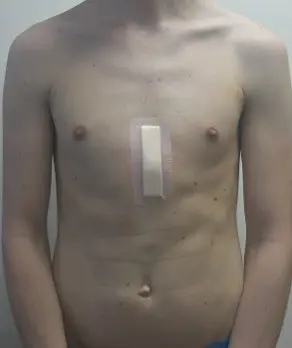
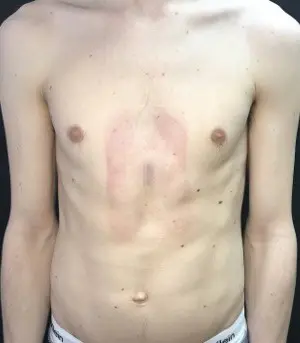
A man in his late 20s with a symmetric pectus carinatum. His chest was skeletally mature and rigid, so a brace alone was unlikely to correct it.
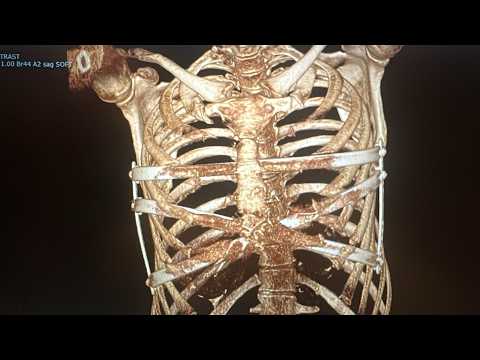
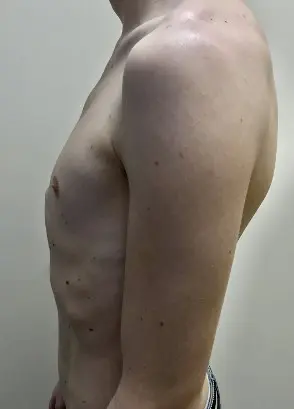
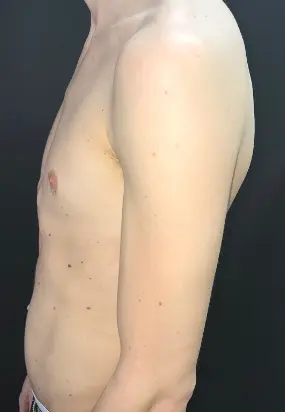
He was treated with a combined approach — a mini-Ravitch to reshape the cartilage and breastbone, followed by a custom brace to refine and hold the result. The CT (right) was used to plan the operation; the photographs below show the journey from before surgery to the healed result.
Hybrid surgery for severe asymmetric pectus excavatum
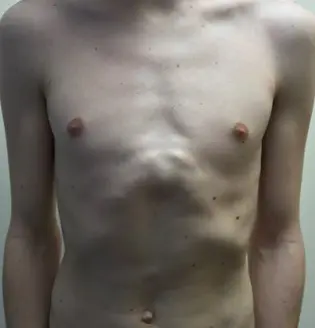
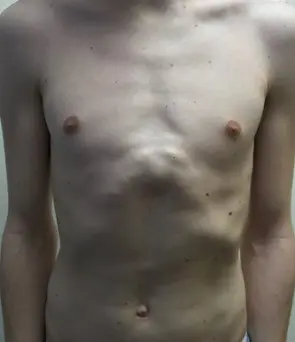
A young patient with a severe, markedly asymmetric pectus excavatum and significant rotation of the breastbone — among the most challenging chest shapes to correct, and beyond what a keyhole bar could achieve on its own.
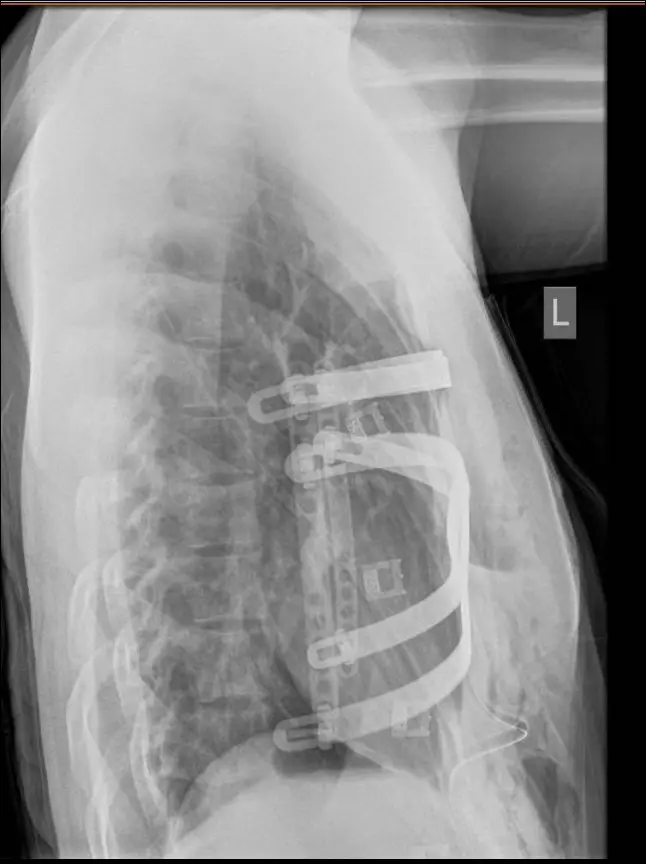
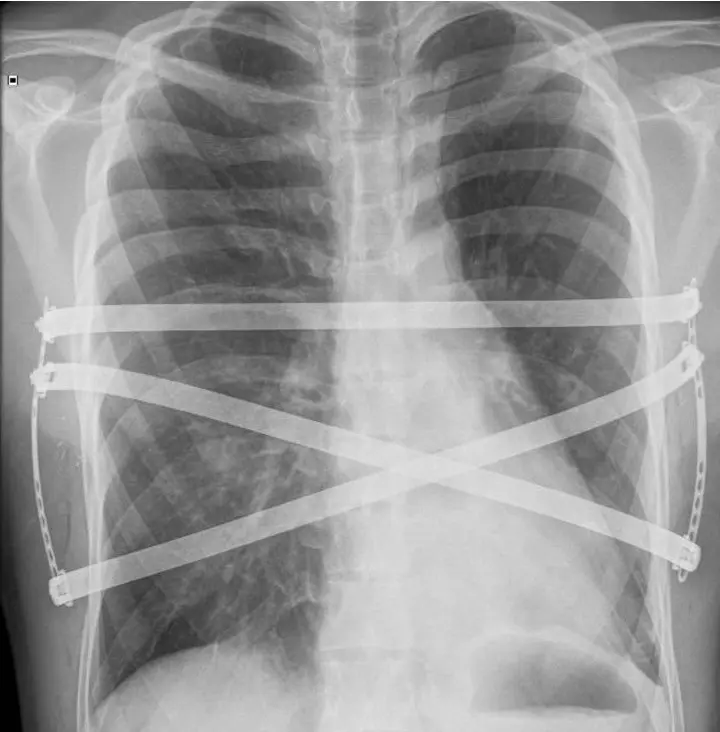
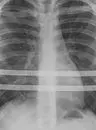
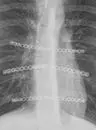
The deep, rotated chest was corrected with a hybrid operation. Through a short incision at the front of the chest, a limited (“mini”) Ravitch released and de-rotated the stiff, abnormal costal cartilages. A keyhole (thoracoscopic) Nuss was then performed, placing three titanium bars in a crossed (“XI”) configuration to lift the breastbone forward and hold the corrected, balanced shape. Cryotherapy to the rib nerves was used during surgery for prolonged pain relief.
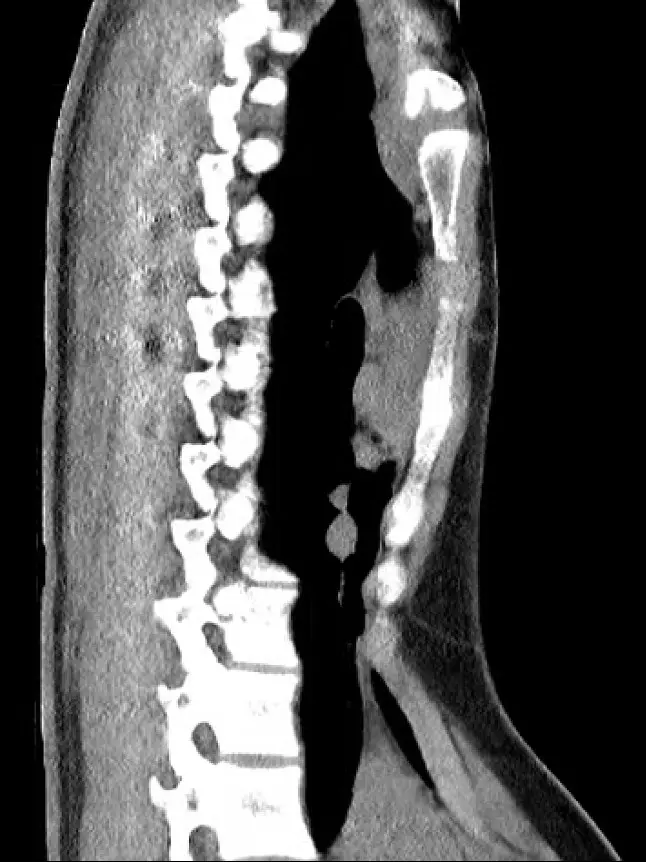
The CT (right) shows the depth and rotation before surgery; the X-rays below confirm the corrected position held by the three bars, which are removed at a later, smaller operation.
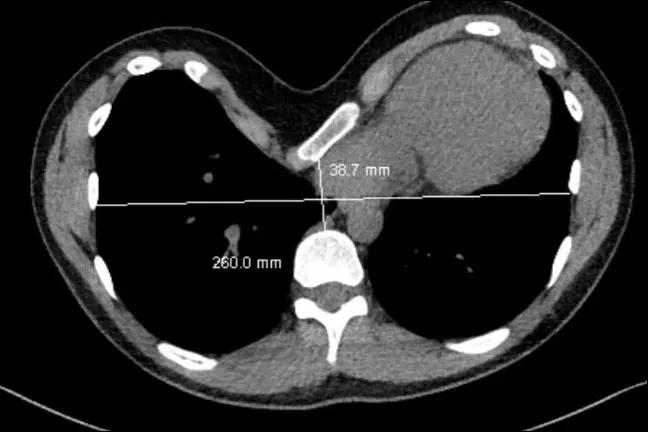
During the operation
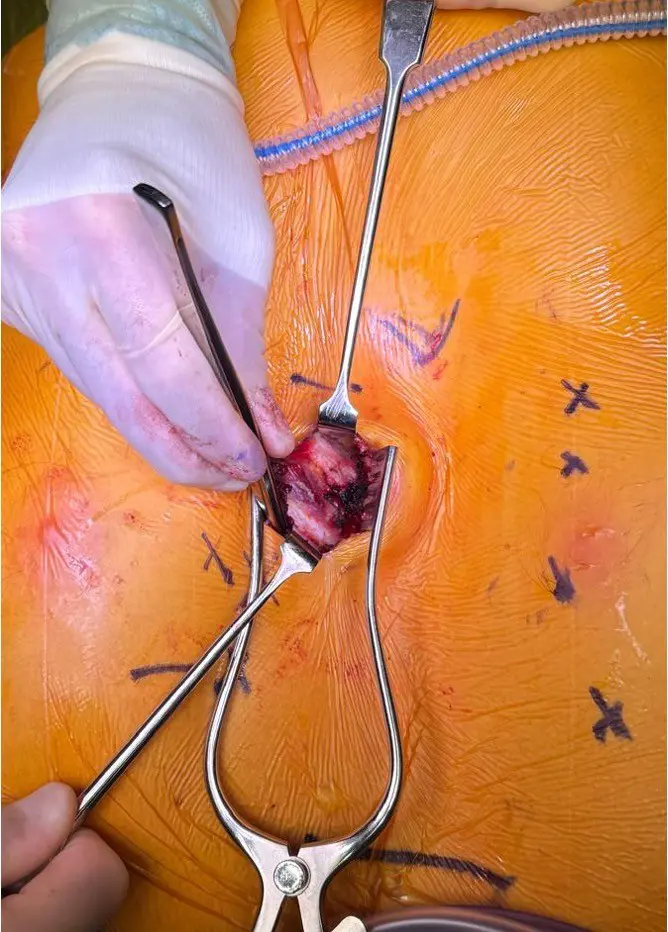
Imaging — before & after
Hybrid correction on video
This narrated operative video, produced by Mr Hunt’s colleague Mr Joel Dunning, shows the same kind of hybrid correction of a very severe pectus excavatum — combining a keyhole Nuss with cartilage division (chondrotomies) and cryotherapy, the principles used at the Pectus Clinic.
FeaturedModern Nuss / hybrid procedure for very severe pectus →
Visit Mr Dunning’s channel →This is an external video hosted on YouTube and contains surgical footage.
Recovery
Recovery is steady and staged, taking about three months overall, and depends on the operation. A hybrid excavatum repair — with bars inside the chest — is the more involved operation, more uncomfortable at first and slower to settle. A combined carinatum correction (a mini-Ravitch from the front, with no internal bars) is generally quicker and less painful. The guidance below is the fuller, hybrid timeline; combined patients are usually a step ahead.
Typically 3–4 nights
A chest X-ray confirms the result. Pain is managed with a patient-controlled (PCA) pump and regular medication. You are up and walking, with breathing exercises, the day after surgery; drains are removed as they settle. A combined carinatum mini-Ravitch is usually shorter — around 2 nights.
At home — the first 12 weeks
Settle & protect
- Sleep on your back; good posture; avoid sudden bending, twisting, heavy lifting and backpacks.
- Walking and deep-breathing exercises from day one. A carinatum brace, where planned, is started as advised.
- Regular painkillers for about 4–6 weeks; the chest may feel numb for several months after cryotherapy.
Back towards normal
- Graded return to gentle aerobic exercise from around 6–8 weeks.
- Continue to avoid heavy lifting and contact sport until about 3 months.
Full activity
- Most return to full activity and sport by around 3 months; vigorous and contact sport up to 6 months.
- Where a Nuss bar was used it is removed at a later, smaller operation (usually around 3–4 years).
Contact the team — or attend A&E if urgent — if you develop: a fever; a persistent cough; worsening chest pain, especially on deep breaths; sudden breathing difficulty; redness, swelling or discharge from the wound; or a sudden change in the shape of your chest with pain.
Risks
As with any major surgery these operations carry risks, which are discussed fully before surgery.
Common & usually minor
- Pain in the first weeks, controlled with planned pain relief and cryotherapy
- Bruising, swelling and a fluid collection under the skin (seroma), settling with time and a support band
- Temporary numbness of the skin around the scar
Uncommon
- Bleeding (up to ~5%), occasionally needing a drain or return to theatre
- Air or fluid around the lung (pneumothorax, or pleural effusion in under 1%)
- Wound infection — deep infection involving the metalwork is rare
- Displacement of a bar or plate (around 2%, mostly in the first six weeks)
Rare but serious
- Persistent pain, or an unstable sternum with abnormal chest-wall movement or clicking — occasionally needing further surgery
- Recurrence of the deformity (uncommon; usually minor)
- Injury to the heart or major vessels — extremely rare, with every precaution taken
Before & after
Clinical photographs of Mr Hunt’s hybrid and combined corrections, shared with patient consent, are being prepared for this section. Female cases are shown behind a click-to-reveal cover.
 Before
 After
After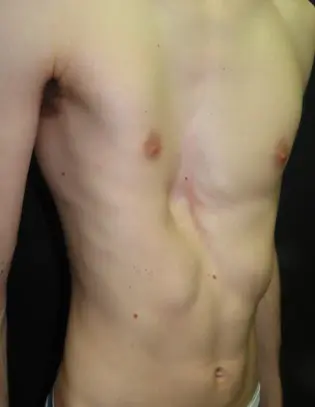 Before
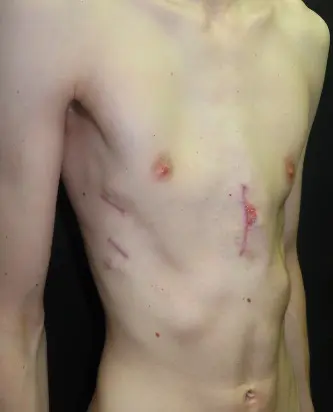 After
After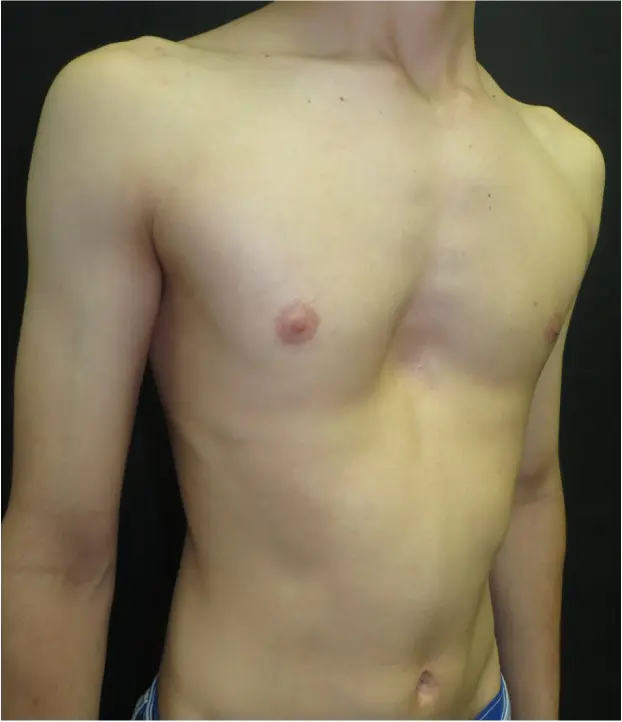 Before
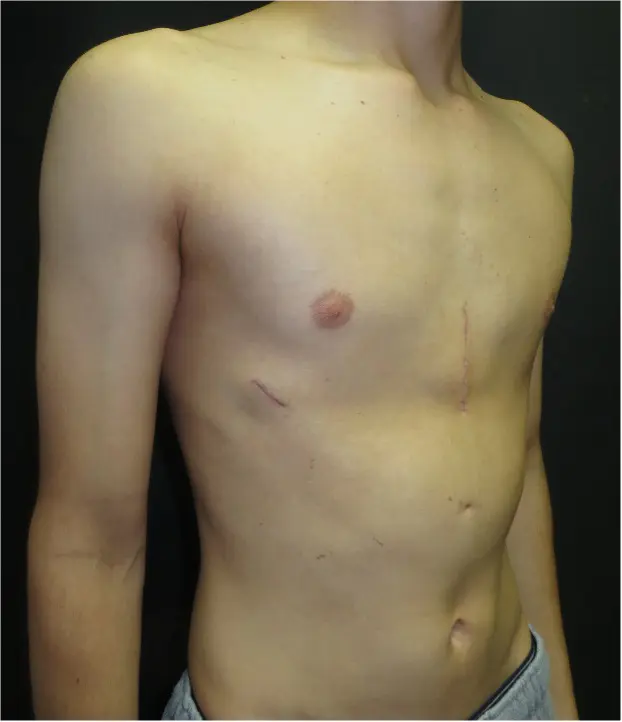 After
AfterCosts and funding
How combined surgery is funded depends on the deformity. Correction of severe pectus excavatum with documented functional symptoms may be funded through private insurance or, in defined cases, the national NHS pectus programme. Surgery for pectus carinatum is treated as a contour procedure and is almost always self-pay.
Only for severe pectus excavatum, through a defined national pathway — pectus carinatum is not NHS-funded. For excavatum, NHS England funds surgery for patients with very severe, objectively documented symptoms: referral → specialist assessment → investigations → independent review at a National Pectus MDT → if accepted, surgery at a national pectus centre. Where an NHS route is realistic this is discussed honestly at consultation.
Private medical insurance. For pectus excavatum and complex cases, many insurers fund surgery where there is documented functional impact. The assessment pathway is designed to provide this evidence, and the team is experienced in supporting pre-authorisation.
Self-pay. A clear written quotation is provided after consultation, covering surgical, anaesthetic and hospital fees and follow-up. As a guide, a hybrid excavatum package is approximately £20,000 (similar to a Nuss procedure); a combined carinatum operation is from around £11,000, which includes the cost of the custom brace. Where a bar is used, its later removal is quoted separately.
Hybrid & combined surgery — FAQs
It combines a keyhole Nuss bar with a limited (“mini”) Ravitch. The bar lifts the breastbone while the mini-Ravitch releases stiff or asymmetric cartilage — together correcting complex excavatum that a bar alone cannot.
For selected carinatum, a mini-Ravitch corrects the protrusion and bracing refines and holds the contour during healing — giving a more reliable result than either alone in selected patients.
For straightforward shapes a single technique is best. Combined surgery is reserved for complex, asymmetric, mixed, rigid or recurrent chests, where pairing techniques gives a more reliable correction with no more surgery than necessary.
It depends on the operation. A hybrid excavatum repair usually means around 3–4 nights in hospital, desk-based work in 4–6 weeks, gentle aerobic exercise from about 6–8 weeks, and most sport by around 3 months (contact sport up to 6 months). A combined carinatum operation is quicker — about 2 nights and back to office-based work in 2–4 weeks — with light exercise from 6–8 weeks and full, unrestricted exercise from about 3 months.
A Nuss bar is temporary and is removed at a later, smaller operation, usually after around 3–4 years. Any small plates used in the mini-Ravitch are designed to stay permanently and are removed only if they cause problems.
Yes — for a combined carinatum correction the custom brace is part of the treatment. It is measured and made before surgery, started about 2–4 weeks afterwards, and worn for around 6–9 months (typically about 12 hours a day, evenings and overnight) to refine and hold the corrected shape.
Severe pectus excavatum with documented functional symptoms may be covered by private insurance or meet the national NHS pectus pathway. Pectus carinatum is generally self-pay. Your situation is explained clearly at consultation.
Find out if combined surgery is right for you
Suitability is determined at consultation. Send a brief description and photographs — Mr Hunt will review — or book directly.